

UD190 Torque Head
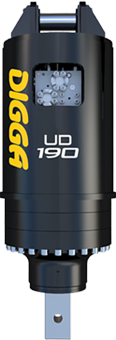
UD190 Torque Head
Ultra drive 2-speed torque heads
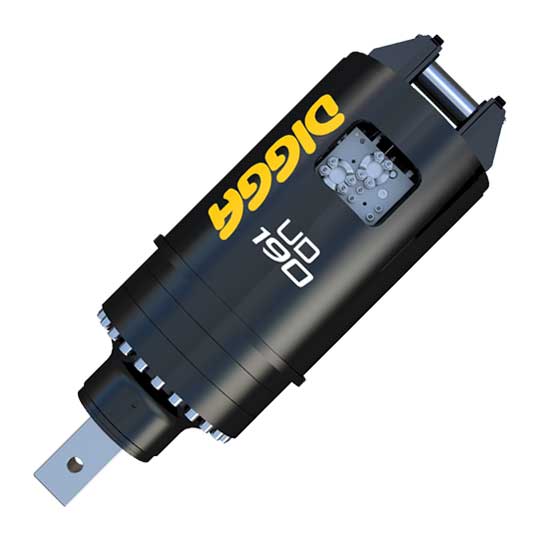
Digga’s Ultra Drive 2-speed torque heads offer exceptional efficiency and performance for anchor installation. The high-speed setting boosts productivity on smaller jobs, while the low-speed, high-torque mode provides precision for tougher installations. A patented anti-kickback valve prevents rapid oil decompression, extending the drive’s lifespan. The high-efficiency radial piston motor ensures consistent performance and optimal power use. Built for durability, the heavy-duty gearbox and extreme-duty shaft locking system handle up to 380 lpm without requiring machine detuning. No complex hoses or filtration are needed. Backed by a 1-year gearbox and motor warranty.

Speeds

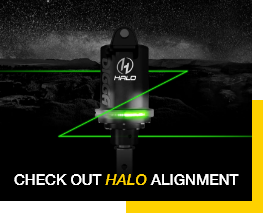
Halo Alignment System

Machine Suitability

Optimum Torque Range

Ideal Application

Warranty
Jump to:
Specifications
Jump to:
Operator's Manuals
Jump to:
About Torque Heads
Jump to:
FAQs
Features

Wider Range Of Applications. Install small and larger piles with just one drive unit, with the best of both worlds: High speed when you need it, and high torque allowing you to take on that slightly larger job with the same equipment.

Powerful. Outstanding power-to-weight ratio, combining a high-efficiency radial piston motor with a precision-engineered Digga gearbox, for exceptional performance.

Lifetime Shaft Pull-out Warranty. Equipped with in-house designed, & manufactured shaft locking nut, this system is guaranteed to prevent shaft pull-out.

Built Tough. Digga gearboxes are built to last, renowned for their quality, dependability, and a legacy of trusted performance spanning over four decades. Crafted with precision-machined gears, delivering outstanding performance, reliability, and an excellent return on investment.
Specifications
The UD190 two-speed torque head delivers speed and performance without the need to detune your machine. Its two-speed control effectively gives you two drives in one—high speed for light materials, smaller drill tools, hole cleaning, and spin-off, and high torque for demanding ground conditions and large diameter drilling tools. Available to suit both 12 V or 24 V machines, the UD190 is compatible with a wide range of machines, handling up to 380 lpm at 240 bar for exceptional peak horsepower capability. Designed for professional drillers, it offers unmatched performance, reliability, and efficiency in the toughest of applications.
Specifications
| Machine Size Suitability | Up to 28 tonnes |
| Recommended Flow | Up to 380 lpm |
| Nominal Torque | 186,644 Nm |
| Pressure Valve | Included |
| Energy Control Valve | Included |
| Case Drain Recommended | Yes |
Build Information
| Overall Length | 1,915 mm |
| Diameter | 671 mm |
| Weight (Without Frame) | 1,194 kg |
| Standard Output Shaft | 150 mm Square |
| Maximum Pressure | 240 bar at 380 lpm |
| Maximum Flow | 380 lpm at 240 bar |
| Maximum Power | 150 kW (200 hp) |
| Swing Control | Not Applicable |
| Diggalign | Optional |
| Halo Available | Not Applicable |
Torque / Speed Charts
Torque chart (Nm)
| Pressure (bar) | High Output Torque (Low Speed) | Low Output Torque (High Speed) |
|---|---|---|
| 100 | 77,768 | 38,884 |
| 110 | 85,545 | 42,772 |
| 120 | 93,322 | 46,661 |
| 130 | 101,099 | 50,549 |
| 140 | 108,875 | 54,438 |
| 150 | 116,652 | 58,326 |
| 160 | 124,429 | 62,215 |
| 170 | 132,206 | 66,103 |
| 180 | 139,983 | 69,991 |
| 190 | 147,759 | 73,880 |
| 200 | 155,536 | 77,768 |
| 210 | 163,313 | 81,657 |
| 220 | 171,090 | 85,545 |
| 230 | 178,867 | 89,433 |
| 240 | 186,644 | 93,322 |
Speed chart (RPM)
| Flow (lpm) | Low Output Speed (High Torque) | high Output speed (Low Torque) |
|---|---|---|
| 100 | 2 | 4 |
| 120 | 2 | 5 |
| 140 | 3 | 6 |
| 160 | 3 | 7 |
| 180 | 4 | 7 |
| 200 | 4 | 8 |
| 220 | 5 | 9 |
| 240 | 5 | 10 |
| 260 | 5 | 11 |
| 280 | 6 | 11 |
| 300 | 6 | 12 |
| 320 | 7 | 13 |
| 340 | 7 | 14 |
| 360 | 7 | 15 |
| 380 | 8 | 16 |
Output speed and torque specifications are theoretical. Speed and torque outputs are dependent on overall system efficiencies associated with the prime mover's hydraulic system. This information should be used for comparative purposes only. When determining criteria, application-specific information is required. please contact DIGGA.
Mounts
Hitches
As with frames, hitches are also connectors used between the parent machine and attachment. Digga manufactures a range of hitches up to 90 tonne excavators. Configurations include single pin, double pin, fixed, loose pin, and the Digga-developed Ryno hitch for larger drives.
Ryno Hitch
Digga’s Ryno Hitch was designed to make it easier to connect large augers and anchors onto a drive unit. Using a Ryno Hitch will eliminate the costly need for a crane to connect screw anchor tools to your earth drill or torque head. Specifically designed to handle the torsional loads of screw anchors and screw piling, the Ryno Hitch allows the operator to cradle the drive unit up to a 90 degree angle for easy connection to augers or screw anchors. It suits Supa Drives, Mega Drives, Ultra Drives, and Xtreme Drives (4,000 Nm – 500,000 Nm).
Accessories
Energy Control Valve (ECV)
Digga’s Energy Control Valve (ECV) protects hydraulic motors during screw piling by controlling rotational energy kickback, preventing motor damage and costly repairs. It easily converts any Digga PD drive into a dedicated screw anchor drive and is standard on all Digga torque heads. Ideal for screw piling and anchoring.
2 Way Flow Reversal Valve
Digga’s 2-Way Flow Reversal Valve converts a single-flow hammer circuit into bi-directional flow, enabling forward and reverse control for auger drives and other attachments using a 12 or 24-volt signal. Integrated valves bolt to Digga top port motors for enhanced protection and fit models from PD4HF to PD10HF and PD12 to PD50. External valves mount on the host machine, allowing two-way control for up to 115 lpm or 300 lpm flow, and are compatible with non-Digga motors and other attachments.
Pressure Differential Gauge
Differential Pressure Gauge uses transduces located within the drive unit to calculate actual pressure received to the power head. The calculation is achieved by measuring the pressure from the feed line and subtracting the back pressure in the return line.
The differential pressure is then displayed in the operator’s cab. The operator can cross reference the displayed figure with the supplied torque chart to determine the theoretical output torque of the drive unit. To suit torque heads (6,000 Nm to 500,000 Nm).
Torque Hub
The Torque Hub measures actual live torque generated by the drive unit by way of a load cell. This converts the mechanical force into digital values that the operator can read and record through the wireless 178 mm display. The display is connected via WiFi for a more reliable connection.
The Torque Hub is over 99 % accurate, it also shows the inclination of the pile and allows the operator to manually add pile depth. The data is stored internally and can be exported by the operator to produce pile reports for engineers. To suit torque heads (13,000 Nm to 95,500Nm) with 75 mm or 100 mm Square shafts sizes.
Torque Spool
Utilising the same technology as the Torque Hub, the Torque Spool has the load cell located between two flanges. This allows the operator to change the unit between different size output shafts and different drive tools avoiding adaptors and the need for multiple units.
The Spool uses the same 178 mm display as the Torque Hub which is also connected via WiFi for a more reliable connection. The Torque Spool is1 over 99 % accurate, it also shows the inclination of the pile and allows the operator to manually add pile depth. The data is stored internally and can be exported by the operator to produce pile reports for engineers. To suit torque heads (110,000 Nm to 500,000 Nm).
Diggalign
The Diggalign Inclinometer ensures precise alignment for drilling, screw piling, and core barrelling. Available in standard (2 °) or high-definition (0.5 °) increments, it’s suitable for all machinery and can be retrofitted to existing drives. It highlights misalignment and improves efficiency, working with both 12 V and 24 V systems.
MY.DIGGA.COM
Find everything you need for your Digga attachment - Including operator manuals, safety information, risk assessments, electrical guides, maintenance tips, and 'how to' instructions. Our user-friendly interface and easy navigation ensure that you can quickly access the support and information you need.
LEARN MORE ABOUT TORQUE HEADS
From understanding the different types of torque heads available, to learning about components and maintenance, we hope you find this information helpful.
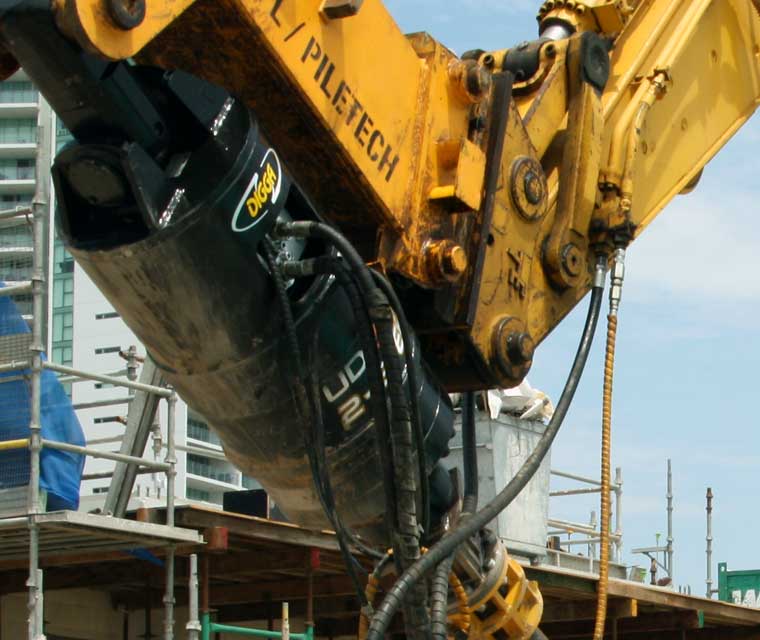
Torque Measuring Systems
Digga offers a range of torque measuring solutions which are operator friendly and easy to install to ensure the correct torque specifications are met and accurate data recorded every time.
Track every turn.
FREQUENTLY ASKED QUESTIONS
Do you sell screw piles?
Digga does not manufacture Screw Piles. Screw Piles are designed and manufactured to meet specific engineered foundation requirements. As such a screw pile is required to be a certified foundation pile to meet the stringent building codes of most countries worldwide.
Digga’s forte lies in the manufacture of the Hydraulic Drive Tool for the effective installation of the screw Pile to meet with the specific torque requirements of the individual screw pile. These torque requirements can be from as low as 1000 Nm up to a massive torque requirement of 500,000 Nm. Digga has a drive head to meet all your torque requirements.
How do I install screw piles?
A screw-pile comprises a circular hollow section of steel shaft with one or more helical plates welded near to the end of it. The size of the shaft (diameter, wall thickness and length), combined with the size and placement of the helical plate are Engineer designed to take full advantage of the available soil capacity. Screw-piles are screwed into the ground like a self-tapping screw using rotary hydraulics, namely DIGGA TORQUE HEADS which are attached to earthmoving equipment, and installed to a specified torque capacity and a depth as directed by a certified foundation engineer.
Why do I need an ECV (Energy Control Valve) or 'Swoosh Valve'
Digga's torque head is used to screw the screw anchor into the ground. As the screw anchor reaches the desired compression torque or depth, the operator stops. At this point the screw anchor is under load.
When the operator stops, the load is trying to spin the screw anchor backwards. While the screw anchor is only tensioned to say a ¼ or ½ a turn, when it releases, it does so in under 1/10 of a second. This motion can have dire effects on both the gearbox and the motor, as it sends reverse energy back up into the drive unit. This motion effectively turns the reduction gearbox into a multiplier, essentially turning the hydraulic motor into a pump.
The Energy Control Valve (ECV) was designed to relieve the kick/flick-back motion of the screw anchor on the drive-head. It does so by controlling the release of oil to the low-pressure side of the motor. The added benefit of the design is that it does not reduce the power available to the unit when the drive is installing the screw anchor. Its unofficial name comes from the sound it makes while working — A gentle 'swoooosshhh' as the oil is released.
When is an ECV (Energy Control Valve) needed on a torque head?
An ECV is required for all drives used installing screw anchors; from PD4HF to PD50. This maintains a full gearbox and motor warranty (3 yr Gearbox and 2 yr Motor).
Should you be installing screw anchors with a torque requirement up to 16,000 Nm and do not have an ECV fitted, you will have limited warranty (2 yr Gearbox and 1 yr Motor).
Using torque heads without an ECV (effectively, an earth drill) for installing screw anchors with an installation torque requirement of greater than 16,000 Nm will have NO WARRANTY for its Gearbox or Motor.
What size torque head do I need for screw piling or screw anchoring?
This will be determined by the maximum torque requirement of the specific screw piles that will be installed at the site in question. This in turn will be specified by the foundation engineer who has designed and designated the exact dimension, installation and torque requirement for this job site.
What size machine is needed for screw anchoring - Does size matter?
This will be determined by the maximum torque requirement of the specific screw anchors that will be installed at the site in question. This in turn will be specified by the foundation engineer who has designed and designated the exact dimension, installation and torque requirement for this job site.
Does rpm speed change when I use larger drive units with more torque?
Dependent on the available flow and pressure available from the parent machine there will be a variation in the rpm speed of a smaller drive to a larger drive.
e.g. With the same parent machine with flow 200 lpm fitted with an SD45 would have 17 rpm at maximum torque, as opposed to same machine with same flow fitted with an SD95 would have 8 rpm at maximum torque. So, a definite flow decrease the larger the torque head.
It is worth noting, speed (rpm) is dependent on Flow (lpm). Power (Nm) depends on pressure (bar).
What is kW and why does it matter?
Every hydraulic motor fixed to a planetary gearbox has a listed maximum power (kW) rating. Exceeding this rating will cause motor damage and failure.
Power is created by combining pressure and flow. You may increase pressure while reducing flow, or increase flow while reducing pressure – maximise both simultaneously may exceed the motor's safe operating limits. The kW power can be calculated with the following formula (kW) = Flow (litres/minute) × Pressure (bar) ÷ 600.
Operating outside the rated kW will cause:
- Excessive heat buildup, degrading hydraulic fluid
- Internal seal and shaft damage
- Motor seizure and failure
- Costly downtime and replacement
Can a torque head for screw anchors be used for auger drilling as well?
Yes, all torque heads are capable of use in screw anchoring and also as an earth drill. Larger torque heads with higher torque capabilities will be limited by the rpm that will satisfy your drilling requirements.
Can my 1.7 tonne machine install screw anchors?
Yes, but the size of the screw anchor would be limited by the amount of torque required, so that the machine is not compromised and is not at risk of boom failure or machine tipping. For safety factors, It is advised to confirm with the machine supplier for the machine in question.
Related Content
Products
Quality affordable attachments and gearboxes to suit most machine types, built tough to last with a factory-backed warranty and full backend support.

About us
We're more than assemblers. Experience the Digga difference, a history of manufacturing innovation since 1981.

Contact us
We're here to help. Whether you have questions about our product range, are ready to order, or have general enquiries - call us.

