

BIGFOOT
Trenchers
The Bigfoot trencher features a skid foot that automatically controls digging depth, which ensures consistent trenching and positioning the spoil auger at the optimal height for efficient material removal. This makes it an excellent choice for both the hire industry (where ease of use is essential for inexperienced operators), and for contractors seeking a reliable, intuitive trencher.
Equipped with a single spoil auger, the Bigfoot directs all spoil to one side, keeping the opposite side clear for easy access and streamlined backfilling.
Compact yet powerful, the Bigfoot trencher delivers reliable, high-performance operation day after day, making it ideal for operators of all skill levels.
Trencher chains
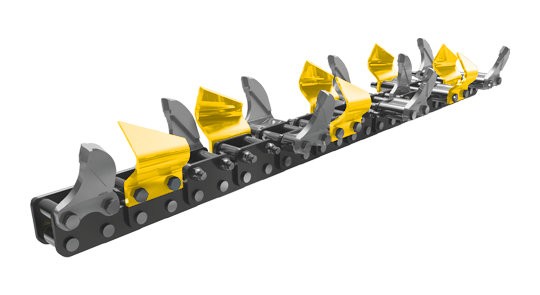
Digga trenchers offer a variety of chain options designed to tackle a wide range of ground conditions. Whether working in soft clean soil, compacted clay, shale, or even soft fracturable rock, there is a suitable chain available to optimise performance. All Digga chains are available in multiple cut sizes and styles, featuring anti back-flex technology to ensure positive tooth engagement with the ground, enhance penetration, and efficiency while reducing chain flex and power loss.
TRENCHER
Chain options
Earth (cupped teeth) provide excellent spoil removal, making them ideal for sticky clay and soft soils.


Full Diggatac chains are designed with improved tooth longevity in mind, which help reduced vibration – Particularly beneficial when trenching in tougher conditions.
Earth/Diggatac combination (combo) chains combine the penetrating ability of Diggatac teeth with the cleaning efficiency of cupped teeth, making it the perfect all-rounder chain for diverse ground conditions.

HOW A HYDRAULIC
Trencher works
The trencher attachment operates using hydraulic power supplied by the host machine. Hydraulic oil flows into the hydraulic motor which converts this flow into mechanical power, driving the planetary gearbox. The motor and gearbox combine to generates the necessary torque to turn the drive shaft, which rotates the drive sprocket. As the sprocket turns, it drives the trencher chain along the boom, and in turn cuts through the ground. After passing through the motor, the hydraulic oil returns to the machine’s tank before being recirculated—continuing the cycle.
Hydraulic system essentials
- Flow (lpm or gpm) controls speed – Higher flow increases chain rotation speed. *Do not exceed recommended flow
- Pressure (bar or psi) generates torque – Higher pressure delivers more digging power. *Do not exceed recommended pressure
- The gearbox oil is independent of the motor – It is a sealed unit that does not receive hydraulic oil from the host machine and is lubricated with gear oil
Hydraulic motor limits
All hydraulic motors have specific operating parameters, including:
- Maximum hydraulic flow
- Maximum hydraulic pressure
- Maximum power input – Combined flow and pressure
⚠ Exceeding these limits can cause severe damage to the trencher.
WHAT IS
Chain Pitch
Chain pitch refers to the distance between the centres of two consecutive pins that hold the cutting teeth. Standard Bigfoot trenchers use a 1-5/8 inch pitch chain, while XD models utilise a 2 inch pitch chain. The appropriate chain size is typically determined by the host machine’s specifications, and matched to the corresponding trencher series for optimal performance and durability.

HYDRIVE
Trenchers
The Hydrive trencher features a dual spoil auger design and operates without a skid foot, requiring the operator to visually maintain both trench depth, and the spoil auger’s height above the ground.
One of its key advantages is its 3-point drive system, which enhances spoil removal efficiency. The dual spoil augers clear material quickly and effectively, keeping the trench clean and optimising workflow.
Another standout feature is the high-drive motor and drive sprocket, positioned at the highest point of the 3-point drive system. This elevated placement keeps the drive sprocket clear of spoil, improving efficiency and extending the system’s longevity. Additionally, the 3-point drive design ensures that the trenching chain remains off the boom, reducing friction, minimizing drag, and further enhancing operational efficiency.
For added operator control, the open-back design provides a clear view of the trenching process, allowing for precise adjustments.
The Hydrive trencher is best suited for experienced operators who can manually maintain an optimum depth (and positioning) throughout the trenching process. It excels in high-duty cycle applications, making it ideal for demanding trenching jobs which require maximum performance and efficiency.
HEADSTART
Crumber
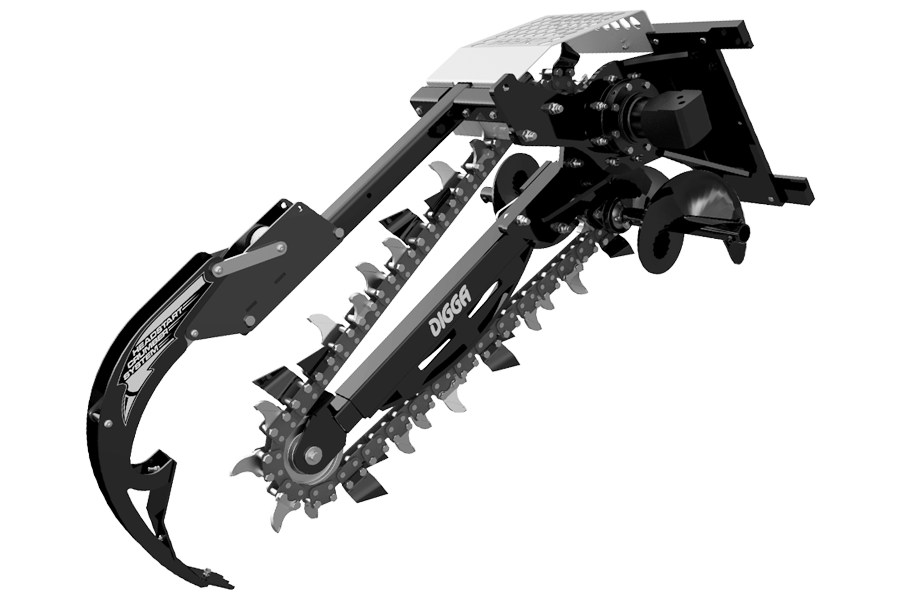
The Headstart Crumber acts as a scraper, ensuring a spoil-free trench by controlling excess material during trenching. It is spring-loaded to maintain constant downward pressure at the bottom of the trench whilst in operation. This design ensures that any missed spoil is scraped back onto the chain and carried to the surface, leaving a clean trench floor.
A key advantage of this design is that the crumber can remain in position from the start of the trench, unlike other brands that require manual repositioning. With some designs, the operator must swing the crumber out of the way to begin trenching, and once at depth, stop the machine, lift the trencher out of the trench, exit the machine, reposition the crumber, then finally lower the trencher back into place.
This process is cumbersome and time-consuming. In contrast, our Headstart crumbing system eliminates the extra steps, to improvie efficiency and ease of use.
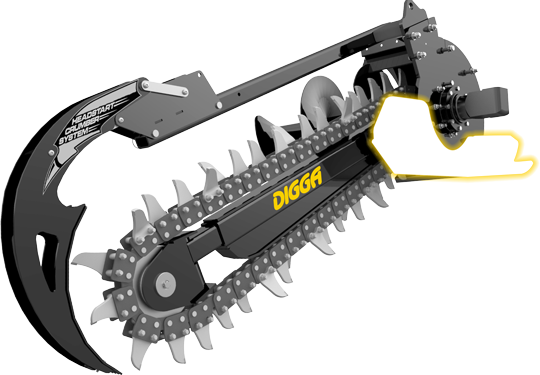
Adjustable skid foot
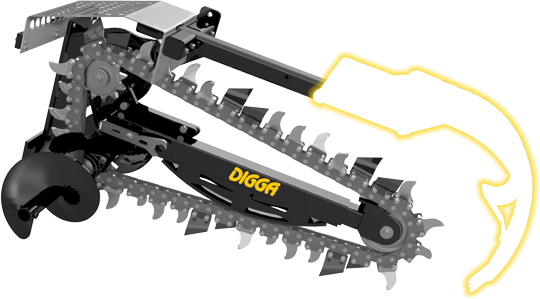
The adjustable skid foot is mounted beneath the hydraulic motor on Bigfoot trencher models, serving multiple critical functions:
- Consistent digging depth: When the skid foot is placed flat on the ground, it indicates the trencher has reached the selected digging depth, providing consistency along the trench length – Taking out the guess work.
- Optimised spoil clearance: The skid foot’s design maintains the spoil auger at the ideal height for efficient spoil removal. If the auger is too high, spoil may fall back into the trench. By contrast, if the auger is too low, it can contact the ground, and reduce trenching power. By consistently positioning the auger to the optimal height, the skid foot ensures maximum trenching efficiency.
- Spoil repositioning: The bent section at the end of the skid foot helps redirect spoil that has shifted to the wrong side of the trench, guiding it back onto the chain for proper removal. This results in a cleaner, more efficient trenching process.
Trenchers without a skid foot, require the operator to manually control trench depth and maintain consistent spoil auger positioning throughout the trenching process.
Bigfoot spoil auger
The Bigfoot series features a single spoil auger that efficiently removes excavated material, depositing it to one side of the trench. This design keeps the opposite side clear, ensuring unobstructed access for laying utilities or other materials while simplifying backfilling.
Hydrive spoil auger
The Hydrive series utilizes dual spoil augers, significantly increasing spoil removal efficiency. With two augers working simultaneously, spoil is cleared rapidly, providing an exceptional trench-cleaning rate and maintaining a cleaner work area.
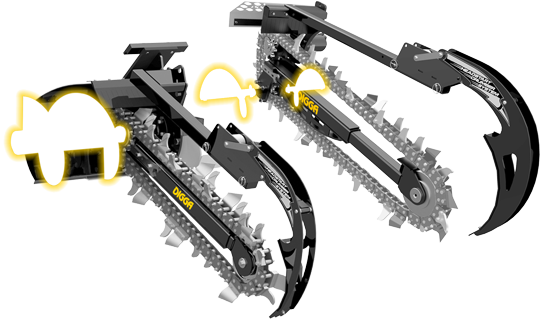
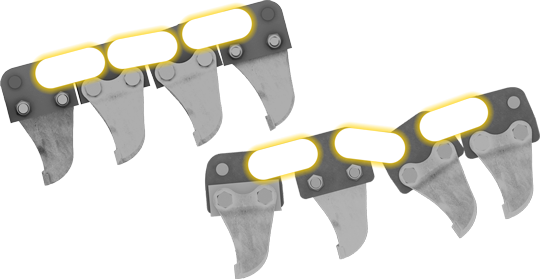
Anti back-flex chains
Digga exclusively uses anti back-flex chains to maintain optimal tooth positioning, ensuring maximum cutting efficiency and consistent ground penetration:
Anti back-flex chain: A reinforced, stable design keeps teeth in the optimal cutting position, enhancing performance and minimizing premature wear for improved durability and efficiency.
Back-flex chain: Allows teeth to shift out of position upon impact, leading to premature wear and reduced cutting efficiency.
Optimised spoil management
Digga’s trenching system produces finely cut material, which can often be reused for backfilling, reducing reliance on external materials. This not only lowers labor and material costs but also enhances overall operational efficiency.
QU'EST-CE QUE
kW ? Et pourquoi c'est important
Chaque moteur hydraulique fixé à un réducteur planétaire a une puissance maximale (kW) indiquée. Le dépassement de cette puissance entraîne l'endommagement et la défaillance du moteur.
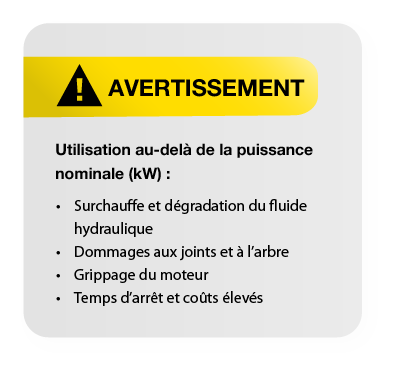
La puissance en kW peut être calculée à l'aide de la formule suivante :
(kW) = Débit (litres/minute) × Pression (bar) ÷ 600
WHICH TRENCHER
Is right for me?
The Bigfoot trencher is ideal for hire fleets, general contractors, and landscapers needing a user-friendly versatile trencher with adjustable depth control. The Hydrive trencher is best for professional trenching contractors. The unique drive system allows increased efficiency for more ‘trench’ per hour. Twin spoil augers clear spoil faster, further increasing productivity. Trench position and depth must be maintained manually, making it ideally suited to experienced operators.
| Compare | Bigfoot Trencher | Hydrive Trencher |
|---|---|---|
| Use | Ideal for inexperienced to experienced operators | Ideal for experienced operators |
| Compatibility | Machines up to 8 tonnes | Machines up to 8 tonnes |
| Trenching Depth | Up to 1500 mm | Up to 1200 mm |
| Trenching Width | Up to 300 mm | Up to 350 mm |
| Depth Control | Adjustable foot | Manual |
| Ideal Application | All | All |
| Drive System | Standard 2 point system | 3 point system for more usable horsepower and efficiency |
| Features | Skid foot enables consistent trenching depth | Motor high out of spoil |
| Single Spoil Auger | Dual Spoil Auger | |
| 100 mm to 200 mm chain cut width with 1.654 inch pitch chain | 100 mm to 300 mm cut width with 1.654 inch pitch chain | |
| 150 mm to 300 mm cut width with 2 inch chain (XD) | 150 mm to 350 mm cut width with 2 inch chain (XD) |
TRENCHER
Frequently Asked Questions (FAQs)
Why would I use a trencher instead of an excavator bucket?
There are a couple of advantages of using a trencher over an excavator bucket:
- When a narrow trench is required 100 mm, 150 mm, 200 mm, you can get a deeper trench, up to 1,500 mm by using a trencher over an excavator trenching bucket.
- Quite often, the spoil that is removed with an excavator trenching bucket is lumpy and unusable for backfill material. As such, it is then needed to be taken away for landfill and soil is then purchased to backfill the trench. With a trencher, the spoil that is removed from the trench is deposited next to the cut trench and is in such a form that it can be then easily reused to backfill the same trench.
Which trencher best suits my machine?
This would all depend on what your application requires, i.e. depth of trench, width of trench, expected ground conditions, and what are the hydraulic capabilities of your host machine.
Once our experienced staff have these details, we will be able to offer the various options to you.
What’s the difference between a Bigfoot and a Bigfoot XD trencher?
The first noticeable difference is in the chain size. The Bigfoot trencher (BFT) uses a 1.654 inch pitch chain, whereas the Bigfoot XD (BFT2) uses a 2 inch pitch chain. The 2 inch chain and teeth are larger and more extreme heavy duty.
The BFT has a maximum chain/trench width of 200 mm. The BFT2 has a maximum chain/trench width of 300 mm. Given that the BFT2 has larger chain and width capabilities, the power/torque of the BFT2 is increased by 20 % over the BFT.
Please refer to our product brochures to determine which model is best suited to your application and host machine.
What is kW and why does it matter?
Every hydraulic motor fixed to a planetary gearbox has a listed maximum power (kW) rating. Exceeding this rating will cause motor damage and failure.
Power is created by combining pressure and flow. You may increase pressure while reducing flow, or increase flow while reducing pressure – maximise both simultaneously may exceed the motor's safe operating limits. The kW power can be calculated with the following formula (kW) = Flow (litres/minute) × Pressure (bar) ÷ 600
Operating outside the rated kW will cause:
- Excessive heat buildup, degrading hydraulic fluid
- Internal seal and shaft damage
- Motor seizure and failure
- Costly downtime and replacement
How deep will my trencher dig?
Our BFT and BFT2 Trenchers have been designed to give you controlled depth options:
- Mini BFT - 450 mm/600 mm/750 mm/900 mm.
- BFT (900) - 600 mm/750 mm/900 mm.
- BFT XD (900) – 450 mm/600 mm/750 mm/900 mm.
- BFT XD (1200) – 600 mm/800 mm/1,000 mm/1,200 mm.
- BFT XD (1500) – 750 mm/1,000 mm/1,250 mm/1,500 mm.
The Hydrive and Hydrive XD depth ranges from 0 mm to 1,200 mm, all governed/guided by the operator’s experience.
Can I replace the chain with a bigger or smaller chain (width)?
Yes, quite simply by loosening off the chain then locating and removing the joiner pin/link. Roll off the chain complete and replace with your smaller or larger width chain as required. Bring the ends of the chain together and replace the joiner pin/link. Retention the chain to the recommended tension as per operator manual guidelines.
Can I change the chain from Earth to Diggatac (earth to rock)?
Yes, you could manually remove every earth tooth, nut, bolt and spacer of your earth chain and replace these with a complete set of Diggatac teeth, nuts, bolts and spacers to reconfigure to a Diggatac Chain. BUT, given the time and effort required to do this it is far more economically viable to have a second complete chain which can be removed and replaced in a fraction of the time.
Can I buy spare parts for my trencher?
Yes, all Digga Trenchers are manufactured in our company owned facilities, guaranteeing spare parts are readily accessible.
Will the trencher cut through tree roots?
Bear in mind the trencher is not a chain saw, but it will cut through the odd tree root. It will also cut through water, power, phone and data cables, so always consult your local services locator before commencing any trenching work.
Do I run the trencher forward or backwards?
When mounted to a skid steer loader or compact track loader, the operator must always operate the trencher in a reverse direction. That is with the top of the chain moving away from the operator and the bottom of the chain coming back towards the operator as it cuts through the soil always while moving the machine in a slow, controlled reverse direction.
When do I need a Crumber Bar?
Crumber Bars (or Scraper Bars) are designed to scrape the bottom of the trench behind the chain as the trencher moves/cuts through the soil, leaving a smooth flat spoil free trench.
In some cases, such as the laying of irrigation pipes, the installer may require a soft bed of loose soil for the pipe to lay on. This can be achieved by simply folding back the Crumber Bar for this application.
NOTE: The 'Danger Bar' that the Scraper/Crumber Bar is fixed to, must NEVER be removed.
Does my tractor or telehandler require a hydrostatic or Vario transmission?
If you wish to mount a trencher on your tractor, telehandler or loader, etc., they MUST always have HYDROSTATIC transmission. There are no tractors, telehandlers or loaders with conventional mechanical gearboxes that can travel slow enough for the effective operation of a trencher attachment. In hard ground conditions you may find the need to be travelling at a rate as slow as 0.075 km/h.
What is a hydrostatic drive?
A hydrostatic drive is a type of transmission system that typically uses fluid power, specifically hydraulic fluid, to transfer energy from a pump to a motor, enabling movement in machinery. It is commonly used in equipment like excavators, tractors, skid steers, and Mini loaders, due to its smooth and precise control over speed and torque. a hydrostatic drive is a fluid-based transmission system that excels in providing precise control, durability, and high torque.
What maintenance is required for the trencher?
Digga trenchers have a Digga planetary gearbox fitted and do require periodic oil changes, as most mechanical devices do. Consult your operator manual for direction.
Besides gearbox maintenance, it is best practise to periodically check the tension of your chain and of the chain tooth wear. The teeth of the trencher are a wearpart and as such may require replacement. Your operator manual has a guide on the loss of efficiency of the chain’s performance relevant to the tooth wear.
Does the trencher chain self-tension if it becomes loose?
No, the trencher chain will require the operator to physically tension the chain as required. All tooling for this is supplied on the trencher, and only takes a few minutes to complete. Your operator manual has a guide on the best practice for correct chain tension.
Still got questions?
We're here to help. Whether you have general enquiries, questions about our product range, want to find your nearest dealer, or are ready to order - contact us today.
 +44 (0) 1488 688 550
Call Us
 [email protected]
Email Us
Related Content
Products
Quality affordable attachments and gearboxes to suit most machine types, built tough to last with a factory-backed warranty and full backend support.
Operating manuals
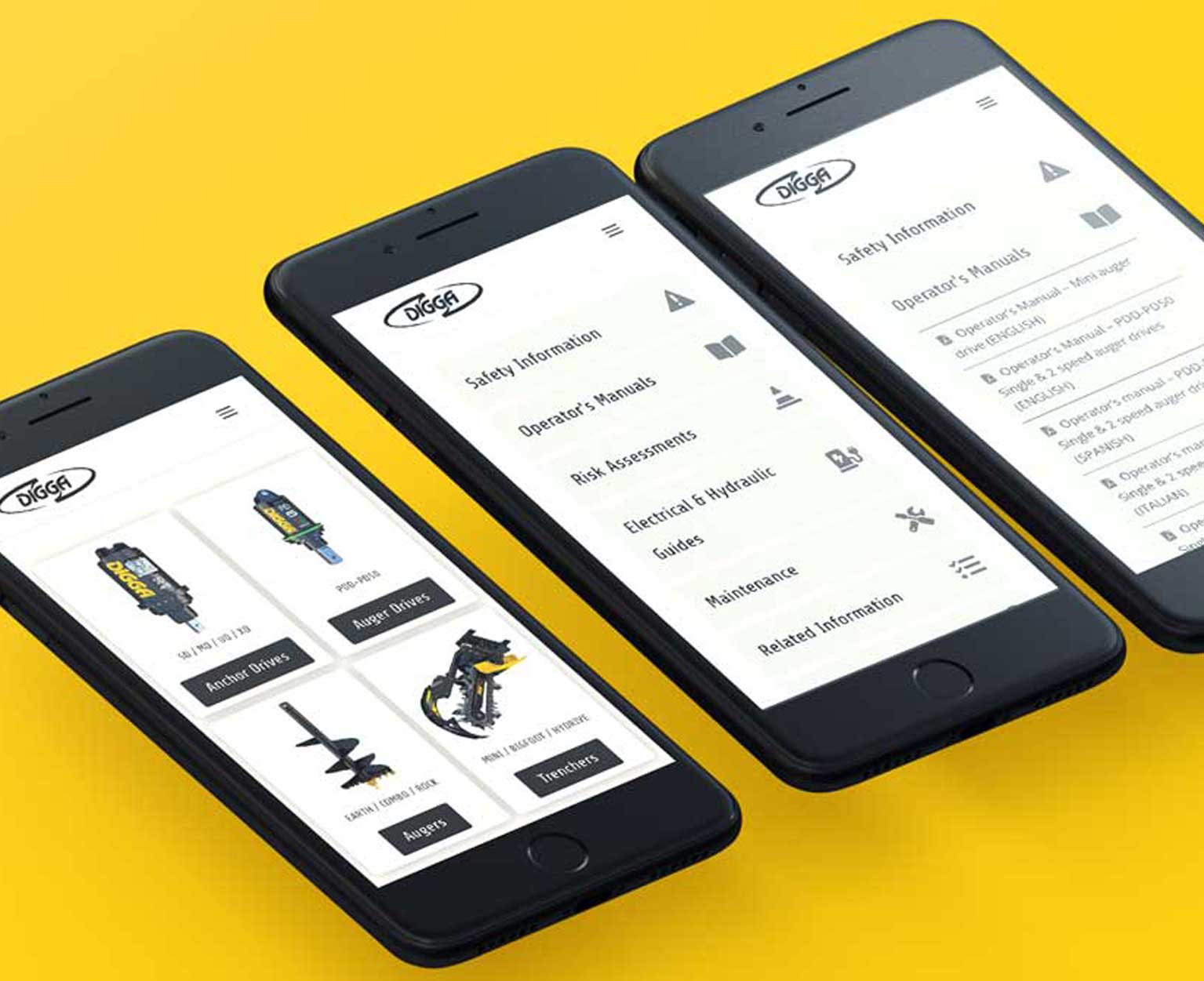
Keep your equipment in top working condition, access product information, manuals, and 'how-to' guides, with MyDigga.

Contact us
We're here to help. Whether you have questions about our product range, are ready to order, or have general enquiries - call us.

